

Few experiences are as unsettling as the sudden sensation that the room is spinning, tilting, or dropping away from under your feet. For millions of people, dizziness and chronic balance issues are not just fleeting annoyances but debilitating conditions that shrink their world. Simple acts like rolling over in bed, walking down a grocery store aisle, or quickly turning to answer a question can trigger intense waves of vertigo and nausea.
When these symptoms become a persistent part of life, standard medications often fall short, merely masking the symptoms rather than addressing the root cause. This is where vestibular rehabilitation therapy steps in. As a highly specialized form of physical therapy, it is designed to alleviate both the primary and secondary problems caused by vestibular disorders. By leveraging the brain’s inherent ability to adapt and rewire itself, this therapy offers a permanent pathway out of the spin cycle.
Understanding the Root of the Problem: The Vestibular System
To understand how this therapy works, it is necessary to first understand the complex machinery of human balance. The vestibular system is a tiny, intricate network of fluid-filled tubes and sacs located deep within the inner ear. It acts as the body’s internal gyroscope.
This system relies on three semicircular canals that detect rotational movements of the head, and two otolith organs—the utricle and saccule—that detect linear movements and the constant pull of gravity. As your head moves, the fluid inside these structures shifts, bending microscopic hair cells that send rapid-fire electrical signals through the vestibulocochlear nerve directly to your brain.
However, your brain does not rely on the inner ear alone. Perfect balance requires a seamless integration of three distinct sensory inputs: the vestibular system in your ears, your visual system, and the somatosensory system, which involves the proprioceptive feedback from your muscles and joints. When your inner ear functions properly, these three systems corroborate each other’s stories.
Dizziness and vertigo occur when there is a mechanical or viral disruption in the inner ear. Suddenly, your brain receives conflicting information. Your eyes and joints might report that you are standing perfectly still, but your damaged inner ear sends panicked signals that you are tumbling forward. This sensory mismatch is what produces the nauseating, spinning sensation known as vertigo. Vestibular therapy works specifically to resolve this mismatch.
Common Conditions Treated by Vestibular Therapy
Vestibular rehabilitation is not a generalized treatment; it is highly targeted based on the specific pathology affecting the inner ear. Several distinct conditions respond remarkably well to this specialized intervention.
Benign Paroxysmal Positional Vertigo (BPPV)
BPPV is the most common cause of vertigo in adults. It occurs when tiny calcium carbonate crystals, normally embedded in the otolith organs, break loose and migrate into the semicircular canals. When you change head positions—such as lying down or looking up—these crystals disrupt the fluid in the canals, sending false movement signals to the brain. This results in brief but violent episodes of spinning.
Vestibular Neuritis and Labyrinthitis
These conditions are typically caused by viral infections that inflame the inner ear or the vestibular nerve itself. Patients often experience a sudden, severe onset of vertigo that can last for days, followed by weeks or months of lingering unsteadiness and brain fog. Even after the infection clears, the nerve damage can leave behind a permanent deficit in that ear’s function.
Meniere’s Disease
Characterized by fluctuating episodes of vertigo, ringing in the ears, ear fullness, and hearing loss, Meniere’s disease is believed to stem from abnormal fluid pressure within the inner ear. While therapy cannot stop the active fluid fluctuations, it is highly effective at helping patients rebuild their baseline balance and confidence between active flare-ups.
Post-Concussion Syndrome
Traumatic brain injuries, including mild concussions, can damage the central vestibular pathways in the brain rather than the inner ear itself. People with post-concussion syndrome often struggle with complex visual environments, motion sensitivity, and headaches. Therapy in these cases focuses heavily on central nervous system integration.
The Core Mechanisms: How Vestibular Therapy Actually Works
The central principle of vestibular rehabilitation is vestibular compensation. If one inner ear is permanently damaged, the brain can actually be trained to rely on the healthy ear, along with enhanced visual and physical cues, to restore normal balance. This is achieved through neuroplasticity—the brain’s ability to forge new neural pathways. Therapists use four main categories of treatment to force this adaptation.
Canalith Repositioning Maneuvers
For patients with BPPV, traditional exercise is not the answer; mechanical correction is. Therapists use specific sequences of head and body movements, most notably the Epley maneuver, to physically guide the rogue calcium crystals out of the semicircular canals and back into the utricle where they belong. When performed by a trained professional, these maneuvers can resolve BPPV in just one or two short sessions.
Gaze Stabilization Exercises
When the inner ear is damaged, patients often lose their vestibulo-ocular reflex. This is the reflex that automatically moves your eyes in the exact opposite direction of your head, allowing you to keep your vision focused on a stationary object while moving. Without it, the world appears to bounce or blur whenever you walk or turn your head. Gaze stabilization exercises force the patient to focus on a fixed target while moving their head at increasing speeds and varying angles. Over time, this forces the brain to rebuild the reflex, eliminating visual blurring and the associated nausea.
Habituation Training
Habituation is designed for patients who experience dizziness triggered by specific movements or visually stimulating environments, like scrolling on a computer screen, watching action movies, or walking across a patterned carpet. The therapy involves deliberate, repeated exposure to the exact stimuli that provoke the dizziness. By safely and systematically triggering a mild level of symptoms, the brain is gradually desensitized. Much like building up a tolerance to a spicy food, the brain eventually learns to ignore the abnormal signals, and the dizziness fades away.
Balance and Gait Retraining
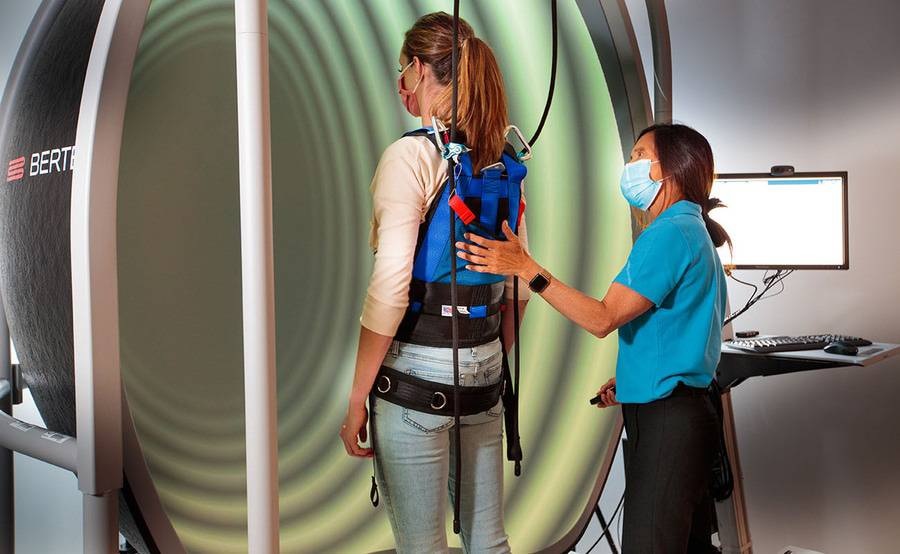
To prevent falls, therapists challenge a patient’s overall stability by purposefully manipulating their sensory inputs. A patient might be asked to stand on a foam cushion to reduce joint feedback, or close their eyes to remove visual feedback. By systematically taking away different sensory crutches in a safe environment, the therapist forces the brain to strengthen its reliance on the remaining balance systems. This progresses to dynamic walking exercises involving head turns, obstacle courses, and tandem walking, all designed to prepare the patient for the unpredictable nature of the real world.
The Patient Experience and the Road to Recovery
The journey through vestibular therapy begins with a comprehensive clinical assessment. Because dizziness is entirely invisible, therapists rely on specialized testing, sometimes using infrared goggles to track involuntary eye movements, to pinpoint exactly which part of the vestibular system is failing.
Once a deficit is identified, the therapist creates a highly customized home exercise program. This is a critical factor: vestibular therapy is not something that only happens in a clinic once a week. It requires daily, diligent practice. The exercises are specifically designed to challenge the brain, which means they will temporarily provoke the patient’s dizziness. Understanding this reality is vital. Patients often feel slightly worse immediately after their exercises, but this controlled provocation is exactly what signals the brain to adapt and heal.
Compliance and consistency are the main drivers of success. Most patients notice significant improvements within a few weeks, though full compensation for severe nerve damage can take a few months of dedicated work.
Beyond simply stopping the room from spinning, the ultimate goal of this therapy is the restoration of confidence. Chronic dizziness often breeds intense anxiety; people begin avoiding social events, driving, and physical activity out of a very rational fear of falling or experiencing an attack in public. By directly addressing the mechanical and neurological failures causing the dizziness, vestibular therapy dismantles that fear. It allows individuals to trust their bodies again, granting them the freedom to move through their lives with steadiness, clarity, and peace of mind.

Comments are closed.